Un système de vision industrielle qui ne détecte pas correctement les défauts peut rapidement devenir un point critique en production. Dans de nombreux cas, ces limites ne viennent pas du principe de la vision industrielle, mais du fait que le système n’est pas adapté a l’application.
C’est dans ces situations qu’une approche de vision industrielle sur mesure devient nécessaire pour atteindre les performances attendues.
Les symptômes d’un système de vision inefficace
Plusieurs signes peuvent indiquer qu’un système de vision industrielle atteint ses limites :
- défauts visibles mais non détectés
- résultats variables selon les conditions
- sensibilité excessive aux changements d’éclairage
- réglages fréquents nécessaires
- taux de rejet anormalement élevé
- taux de faux positif anormalement élevé
Ces problèmes impactent directement la qualité, la productivité et la confiance dans le système. Dans de nombreux cas, une solution de vision industrielle sur mesure permet d’atteindre des performances impossibles avec une approche standard.
Les causes les plus fréquentes
1. Une optique mal adaptée
L’optique joue un rôle central dans la qualité de l’image. Une configuration inadaptée peut empêcher de révéler correctement les défauts. En guise d’exemple, chez Imasolia, nous traitons des défauts submicroniques, ce qui rend le dimensionnement de la chaîne optique essentiel.
2. Un éclairage inadapté
C’est souvent la principale cause des problèmes. Un éclairage mal conçu peut :
- masquer les défauts
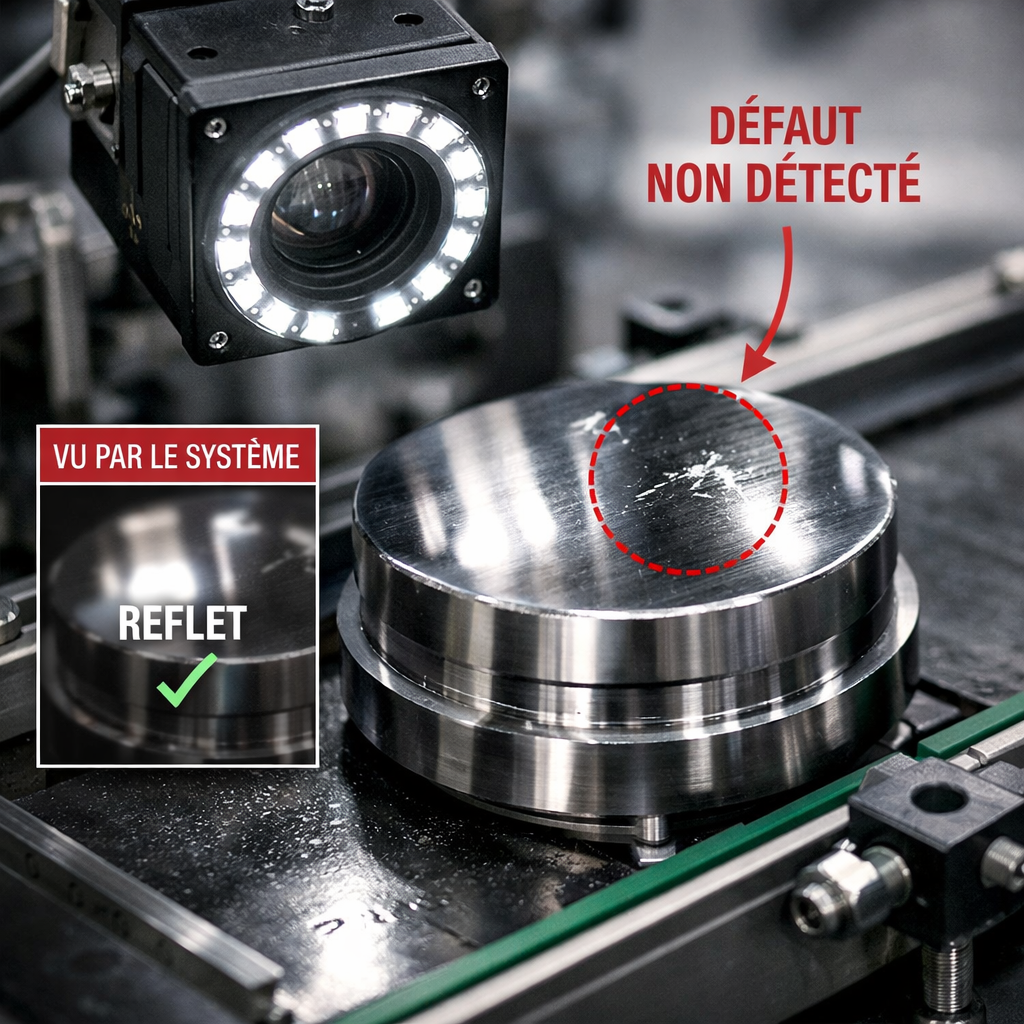
- créer des reflets
- générer du bruit
Nous travaillons régulièrement avec des éclairages spécifiques, adaptés à chaque application. La maîtrise de l’éclairage est un levier essentiel pour révéler les défauts et garantir des résultats fiables en conditions industrielles
3. Des limites liées au capteur
Voici une version plus solide, fluide et orientée valeur 👇
Résolution insuffisante, bruit, dynamique limitée … Le capteur peut rapidement devenir un facteur bloquant dans certaines applications. Le choix et l’intégration du capteur sont donc déterminants pour garantir la qualité des mesures. Chez Imasolia, nous accordons une attention particulière à cette étape, en sélectionnant et en exploitant les capteurs les plus adaptés afin d’assurer des performances fiables, même dans les configurations les plus exigeantes.
4. Un traitement d’image non optimisé
Voici une version plus solide et plus “vendeuse” 👇
Les algorithmes doivent être adaptés à l’application pour exploiter pleinement les données acquises. Une approche générique montre rapidement ses limites dès que les conditions deviennent complexes. Chez Imasolia, nous développons des traitements spécifiques, calibrés pour chaque cas d’usage, afin d’assurer une détection fiable, robuste et exploitable en environnement industriel.
Pourquoi les systèmes de vision industrielle standards atteignent-ils leurs limites ?
Les systèmes du marché sont conçus pour répondre à un grand nombre d’applications. Cette polyvalence est un avantage, mais elle devient une limite lorsque les conditions sont spécifiques. Dans les cas complexes (surfaces brillantes, matériaux transparents, précision élevée), une approche standard ne permet pas toujours d’atteindre les performances attendues.
Dans de nombreux cas, une solution de vision industrielle sur mesure permet d’atteindre des performances impossibles avec une approche standard.
Comment améliorer un système de vision industrielle ?
Avant de changer complètement de solution, plusieurs leviers peuvent être activés :
- revoir la configuration optique
- adapter l’éclairage à la problématique
- améliorer le positionnement ou la stabilité
- ajuster les algorithmes de traitement
- analyser les conditions réelles d’utilisation
Quand passer à une vision industrielle sur mesure ?
Une approche de vision industrielle sur mesure devient pertinente lorsque :
- les solutions standards ne donnent pas de résultats fiables
- les conditions d’inspection sont complexes
- les performances ne sont pas reproductibles
- les exigences de précision sont élevées
Dans ces situations, il ne s’agit plus d’adapter l’application à un système existant, mais bien de concevoir une solution spécifiquement dimensionnée pour le besoin.
Une approche de vision industrielle sur mesure consiste à optimiser l’ensemble de la chaîne de mesure, optique, éclairage, capteurs et traitement, afin de lever les verrous techniques et d’obtenir des résultats fiables en conditions réelles de production. Cette approche permet non seulement d’améliorer la détection des défauts, mais aussi de réduire les rebuts, de stabiliser les performances et d’augmenter la fiabilité du contrôle qualité.
L’objectif est simple : disposer d’un système robuste, reproductible et directement exploitable en production, même dans les configurations les plus exigeantes.
Conclusion
Un système de vision industrielle qui ne donne pas satisfaction n’est pas forcément à remplacer. Dans de nombreux cas, une analyse approfondie permet d’identifier les causes réelles des limitations et d’apporter des améliorations concrètes, parfois avec des ajustements ciblés.
Qu’il s’agisse de l’optique, de l’éclairage, du capteur ou du traitement d’image, chaque maillon de la chaîne peut être optimisé pour améliorer significativement les performances. Cette approche permet souvent de débloquer des situations complexes sans repartir de zéro.
Lorsqu’une solution standard atteint ses limites, une approche plus adaptée permet de transformer un système instable en un outil fiable, exploitable et durable en production.
Vision industrielle sur mesure : aller plus loin
Une approche adaptée permet d’identifier rapidement les axes d’amélioration et d’atteindre des performances fiables en production. Si votre système de vision industrielle ne donne pas les résultats attendus, une analyse rapide permet d’identifier les axes d’amélioration.