Dans l’industrie, une solution de vision standard fonctionne souvent… jusqu’au moment où les conditions réelles de production deviennent trop complexes.
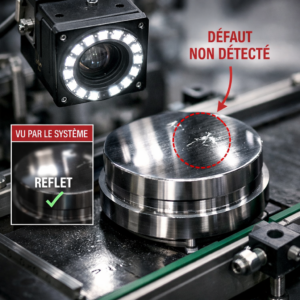
Reflets métalliques, cadence élevée, faible contraste, environnement poussiéreux, variations de pièces, contraintes d’intégration ou encore espace limité : dans ces situations, les systèmes “catalogue” atteignent rapidement leurs limites.
Pourtant, de nombreux industriels continuent de chercher à adapter des solutions génériques à des procédés qui nécessitent en réalité une approche spécifique.
Alors, faut-il privilégier une solution standard prête à l’emploi ou développer un système de vision industrielle sur mesure ?
Les avantages des solutions standards
Les solutions standards occupent une place importante dans l’industrie. Elles permettent de répondre Les solutions standards occupent une place importante dans l’industrie. Elles permettent de répondre rapidement à des besoins simples et bien maîtrisés. Leur principal avantage réside dans leur rapidité de déploiement, leur coût initial généralement plus faible ainsi que la disponibilité immédiate de la documentation et du support technique. Elles facilitent également l’intégration sur des applications classiques tout en simplifiant les opérations de maintenance.
Pour des applications répétitives et peu contraintes, ces solutions constituent souvent une excellente option. Elles sont particulièrement adaptées à des tâches telles que la lecture de codes-barres, la détection de présence, le contrôle simple de position, le tri basique ou encore l’inspection de pièces fortement contrastées.
Dans ce type de contexte, une solution catalogue permet généralement d’obtenir un résultat fiable avec un temps de mise en œuvre limité.
Quand les solutions standards atteignent leurs limites
Les difficultés apparaissent généralement lorsque l’environnement industriel devient plus exigeant. Dans de nombreux projets, le problème ne provient pas directement de l’algorithme, mais des contraintes physiques réelles du procédé industriel. Les surfaces réfléchissantes, les pièces transparentes, les géométries complexes, les sprays ou fluides en mouvement, les variations de lumière, les contraintes mécaniques ou encore les cadences élevées compliquent fortement l’obtention d’une mesure fiable et stable.
Dans ce type de contexte, les solutions génériques atteignent rapidement leurs limites. Elles nécessitent souvent des réglages permanents, des compromis de performance ou des adaptations mécaniques importantes pour parvenir à fonctionner correctement. Il n’est également pas rare que des développements spécifiques doivent finalement être ajoutés, alors qu’ils n’étaient pas prévus dans la solution initiale.
Le risque est alors de transformer une solution présentée comme simple et économique en un projet long, coûteux et difficile à stabiliser durablement.
La fausse économie des systèmes génériques
Une solution standard peut sembler moins coûteuse au départ. Pourtant, dans la pratique, les coûts cachés apparaissent souvent rapidement lorsque le système n’est pas réellement adapté au procédé industriel. Les difficultés peuvent alors prendre différentes formes : temps d’intégration plus long que prévu, faux positifs, faux rejets, arrêts de ligne, maintenance fréquente ou encore performances instables dans certaines conditions de production.
À cela s’ajoutent parfois des limitations plus structurelles, comme l’impossibilité de faire évoluer le système ou la nécessité de réaliser des réglages manuels réguliers pour maintenir un niveau de performance acceptable.
Dans de nombreux projets, le coût réel ne provient finalement pas du système lui-même, mais des pertes de production générées par une solution insuffisamment adaptée à l’environnement industriel.
La vraie question devient alors :
Combien coûte l’utilisation d’un système qui n’a pas été conçu pour votre application ?
L’approche sur mesure : adapter la vision au procédé
Une approche sur mesure consiste à concevoir le système autour des contraintes réelles du procédé industriel. Cela ne concerne pas uniquement le logiciel ou l’intelligence artificielle. La performance globale dépend de l’ensemble de la chaîne de mesure :
- éclairage,
- optique,
- mécanique,
- acquisition,
- synchronisation,
- traitement d’image,
- environnement industriel,
- interface opérateur.
L’objectif n’est pas simplement de visualiser une pièce, mais de garantir une information exploitable et fiable dans des conditions réelles de production. C’est particulièrement vrai dans les applications complexes :
- contrôle de défauts micrométriques,
- inspection à haute cadence,
- caractérisation de sprays,
- contrôle sur surfaces réfléchissantes,
- environnements sous-marins,
- procédés fortement variables.
Solutions standards vs solutions sur mesure
| Critère | Solution standard | Solution sur mesure |
|---|---|---|
| Déploiement initial | Rapide | Adapté au projet |
| Coût de départ | Plus faible | Optimisé selon les contraintes |
| Adaptation au procédé | Limitée | Conçue pour le procédé |
| Gestion des cas complexes | Compromis de performance | Optimisée pour les contraintes réelles |
| Robustesse industrielle | Variable | Stabilisée pour la production |
| Évolutivité | Souvent limitée | Flexible et évolutive |
| Intégration mécanique | Générique | Adaptée à l’environnement industriel |
| Maintenance et réglages | Ajustements fréquents | Réduction des interventions |
| Performance long terme | Sensible aux variations | Fiable dans la durée |
Le bon choix dépend du niveau de complexité
Toutes les applications industrielles ne nécessitent pas une solution spécifique. Une solution standard reste parfaitement pertinente lorsque le besoin est simple, que les conditions de production sont stables, que les pièces présentent peu de variations et que les contraintes industrielles restent limitées.
En revanche, dès que l’environnement devient plus complexe ou critique, une approche sur mesure permet généralement d’obtenir un niveau de performance bien supérieur. En adaptant le système aux contraintes réelles du procédé, il devient possible d’améliorer la fiabilité globale, de réduire les risques industriels, de limiter les pertes de production et d’obtenir une solution réellement exploitable dans la durée.
Concevoir une solution adaptée à votre réalité industrielle
Chez Imasolia, nous développons des systèmes optiques et de vision industrielle adaptés aux environnements complexes. Notre approche combine :
- photonique,
- traitement d’image,
- intelligence artificielle,
- conception optique,
- et intégration industrielle.
L’objectif n’est pas de forcer une technologie existante à fonctionner, mais de construire une solution cohérente avec votre procédé, vos contraintes et vos objectifs industriels.
Conclusion
Une solution standard reste une excellente option lorsqu’un besoin est simple et proche des cas d’usage classiques. Mais dès que les contraintes deviennent spécifiques, la question n’est plus :
Peut-on adapter une solution catalogue ?
La vraie question devient :
Combien coûte le fait d’utiliser une solution qui n’a pas été conçue pour ce procédé ?
Aller plus loin
Vous vous demandez si une solution standard peut réellement répondre à vos contraintes industrielles ?Imasolia vous accompagne dans l’analyse de faisabilité et la conception de systèmes de vision adaptés à votre procédé.